
Guangzhou + Zhuhai + Zhongshan + Shenzhen 5-Day 4-Night Route inspiration
★ [Four-City Tour] Explore the Greater Bay Area with a tour of Guangzhou, Shenzhen, Zhongshan, and Zhuhai, savor the charm of the “Little South China,” experience the local customs of Guangzhou, the coastal scenery of Zhuhai, the benevolence of Zhongshan, and the modern vibe of Shenzhen. Admire the world’s construction marvels, the Shen Zhong Corridor, and the Hong Kong-Zhuhai-Macao Bridge.
Note:
- The city route includes coastal and possible boat outings, not a confirmed rafting activity. Carry weather protection and check any selected boat trip separately.

Itinerary
Day 1 — Canton Tower, old Guangzhou & the Pearl River
Original itinerary heading
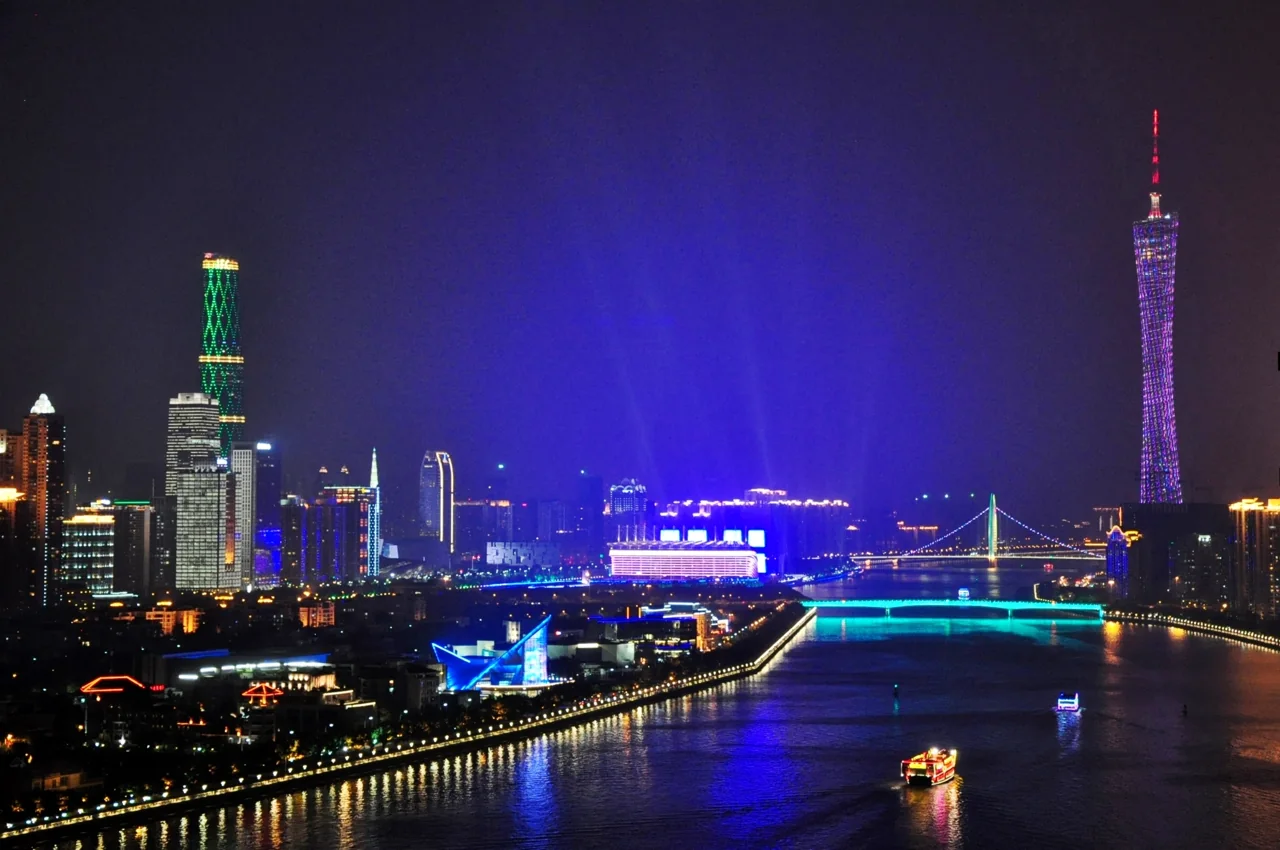
Day 01 — Canton Tower - Sacred Heart Cathedral of Guangzhou (Shi Shi) - Yongqing Fang - Beijing Road - Dafo Ancient Temple - Pearl River Night Cruise.
The Canton Tower (Chinese: 广州塔), formally Guangzhou TV Astronomical and Sightseeing Tower (Chinese: 广州电视台天文及观光塔), is a 604-meter (1,982 ft)-tall multipurpose observation tower in the Haizhu District of Guangzhou (alternatively romanized as Canton). The tower was topped out in 2009 and it became operational on 29 September 2010 for the 2010 Asian Games. The tower briefly held the title of tallest tower in the world, replacing the CN Tower, before being surpassed by the Tokyo Skytree. It was the tallest structure in China prior to the topping out of the Shanghai Tower on 3 August 2013, and remains a distinctive landmark on Guangzhou’s skyline. Planning note: This list crosses several parts of Guangzhou. Choose a river/tower visit or the old-city streets, then an optional evening cruise; a cruise and observation deck are separate purchases.
Day 2 — Whampoa, Sun Yat-sen’s former residence & Zhongshan
Original itinerary heading
Day 02 — Guangzhou (Whampoa Military Academy Site - Sun Yat-sen's Former Residence Memorial Hall - Zhongshan Hot Springs).
The Republic of China Military Academy (Chinese: 中華民國陸軍軍官學校; pinyin: Zhōnghúa Mīngúo Lùjūn Jūnguān Xúexiào; Pe̍h-ōe-jī: Tiong-hôa Bîn-kok Lio̍k-kun Kun-koaⁿ Ha̍k-hāu), also known as the Chinese Military Academy (CMA), is the service academy for the army. It was founded by the Republic of China as the Whampoa Military Academy at Huangpu (Whampoa), Guangzhou in 1924. Its graduates participated in the Northern Expedition, the Second Sino-Japanese War and the Chinese Civil War. Planning note: Sun Yat-sen’s former residence and the hot springs are in Zhongshan, not central Guangzhou. Allow a dedicated intercity transfer; the hot-spring stay is optional and separately booked.
Day 3 — Zhuhai: the bridge, Yuanming New Garden & Xianglu Bay
Original itinerary heading
Day 03 — Zhuhai (View the Hong Kong-Zhuhai-Macao Bridge from the Sea + Yuanming New Garden + Sun and Moon Shell + Xianglu Bay Beach).
The Hong Kong–Zhuhai–Macau Bridge (HZMB) is a 55-kilometre (34 mi) bridge–tunnel system consisting of a series of three cable-stayed bridges, an undersea tunnel, and four artificial islands. It is both the longest sea crossing and the longest open-sea fixed link in the world. The HZMB spans the Lingding and Jiuzhou channels, connecting Hong Kong and Macau with Zhuhai— a major city on the Pearl River Delta in China. Planning note: The bridge view is from the Zhuhai side unless you explicitly arrange a qualifying cross-border journey. Do not assume a sea-view excursion admits every passport or includes Hong Kong/Macao entry.
The HZM Bridge was designed to last for 120 years and cost ¥127 billion (US$18.8 billion) to build. The cost of constructing the Main Bridge was estimated at ¥51.1 billion (US$7.56 billion) funded by bank loans and shared among the governments of mainland China, Hong Kong and Macau.
Originally set to be opened to traffic in late 2016, the structure was completed on 6 February 2018 and journalists were subsequently taken for a ride over the bridge. On 24 October 2018 the HZMB was opened to the public after its inauguration a day earlier by Chinese leader Xi Jinping.
Day 4 — Shenzhen: Lianhua Mountain, Huaqiangbei & Dongmen
Original itinerary heading
Day 04 — Shenzhen (Lianhua Mountain Park - Huaqiangbei Museum - Dongmen Old Street - Diwang Building · Shenzhen-Hong Kong Window).
Huaqiangbei (Chinese: 华强北; lit. ‘Huaqiang North’) is a subdistrict of Futian, Shenzhen, Guangdong Province, China, one of Shenzhen’s notable retail areas; having one of the largest electronics markets in the world. The area’s status as a major electronics manufacturing hub, and sprawling electronics marketplaces have earned it (and Shenzhen) occidental nicknames such as “China’s Silicon Valley”, and the “Silicon Valley of Hardware”. Multiple malls contain various businesses. Planning note: The move from Zhuhai/Zhongshan to Shenzhen takes part of the day. Choose one Shenzhen neighbourhood rather than promise all four stops.
Huaqiangbei contains a mix of electronics markets, component sellers and other retail businesses. Shops and product ranges change; compare specifications, warranties and seller terms rather than assuming every item is a bargain.
Day 5 — Zhongying Street, Yantian & Dameisha
Original itinerary heading
Day 05 — (Zhongying Street + Yantian Coastal Boardwalk - Dameisha Beach Park) - Return Trip.
Chung Ying Street (Chinese: 中英街) is a street on the border between Hong Kong and Shenzhen, within the border town of Sha Tau Kok (Hong Kong) and Shatoujiao (Shenzhen). One side of the street belongs to Hong Kong and the other belongs to mainland China. Planning note: Zhongying Street has special access controls; foreign-visitor eligibility has not been confirmed here. Do not book around access to it. The Yantian coast and Dameisha are alternatives, subject to local weather and access notices; allow a departure buffer.
In Cantonese, Chung means China and Ying England or the United Kingdom. The name is a mark of history of the Second Convention of Peking, a treaty that China under the Qing dynasty was forced to lease New Territories to Britain in 1899.
Chung Ying Street was once a famous place for shopping. In the 1990s, when China was still closed to the world, Chinese tourists visited to buy foreign goods, mostly watches, clothing and jewellery. However, the prosperity has declined in the early 21st century, due to a policy allowing most people from Mainland China to apply to visit Hong Kong directly, causing Chung Ying Street to transform into a place for historical sight-seeing. The PRC government has built a museum about the history of Chung Ying Street to attract tourists again.
FAQs
1. Q: What records did the Canton Tower hold?
2. Q: What is the Republic of China Military Academy?
A: The Republic of China Military Academy, also known as the Chinese Military Academy, was founded as the Whampoa Military Academy at Huangpu, Guangzhou in 1924.
3. Q: What is the Hong Kong–Zhuhai–Macau Bridge?
4. Q: What is Huaqiangbei?
A: Huaqiangbei is a subdistrict of Futian, Shenzhen. It is one of the largest electronics markets in the world and is known as “China’s Silicon Valley” or the “Silicon Valley of Hardware”.
5. Q: What is Chung Ying Street?
A: Chung Ying Street is a street on the border between Hong Kong and Shenzhen. One side belongs to Hong Kong and the other belongs to mainland China.
6. Q: What entry permission does this route require?[2]
A: Check every stop against the NIA permitted-area table; a short itinerary alone does not qualify. For 240-hour transit, eligibility depends on your passport, designated port, confirmed onward travel to a third country or region, and the stay granted. Verify the current NIA rules before booking; otherwise use another valid entry/stay basis.[3]
Before you make arrangements
Check intercity services, any bridge-tour nationality/document restrictions and market opening days. Confirm coastal/weather conditions and any beach-entry requirements before committing.
Notes & sources
These notes support the specific corrections above. They do not mean that every sentence, future opening time or individual eligibility has been verified.
Correction notes and source scope
Remove unsupported sale/group-departure implication while preserving destination names and original duration.
Editorial correction; no new factual-verification date claimed.Replace obsolete 144-hour FAQ with current entry-permission question.
NIA — current visa-free transit policy and permitted-area tableSource checked 2026-10-31Remove blanket 144-hour entitlement and obsolete 2024 guide reference; apply current NIA conditions and route-specific geographical limits.
NIA — current visa-free transit policy and permitted-area tableSource checked 2026-10-31Remove unrelated rafting instruction copied into a city route.
Editorial correction; no new factual-verification date claimed.Remove outdated business counts and unsupported “most smartphones” claim while retaining practical market context.
Editorial correction; no new factual-verification date claimed.Keep original destination narrative; add specific pacing/access constraint for this day.
Editorial correction; no new factual-verification date claimed.Keep original destination narrative; add specific pacing/access constraint for this day.
Editorial correction; no new factual-verification date claimed.Keep original destination narrative; add specific pacing/access constraint for this day.
Editorial correction; no new factual-verification date claimed.Keep original destination narrative; add specific pacing/access constraint for this day.
Editorial correction; no new factual-verification date claimed.Keep original destination narrative; add specific pacing/access constraint for this day.
Editorial correction; no new factual-verification date claimed.
- NIA — current visa-free transit policy and permitted-area table
31 route geographic-scope screenings; image table independently viewed locally. Reopened in this review.
Checked 2026-10-31 - Guangzhou Haizhu government — Canton Tower
Official attraction page points to cantontower.com ticket guidance; no current price copied. Evidence inherited from the 29 October audit; not a fresh operating-calendar check.
Checked 2026-10-29